In 2025, it lost every election it contested, in several cases defeated by the most extreme faction of the right. It truly was an annus horribilis for the democratic left. But now, as 2026 begins, a new opportunity is presenting itself. Interestingly, this wasn’t planned , but rather the result of mistakes made by that same radical right.
At the forefront of this are Donald Trump’s brazen statements, which have a global impact. Every missile strike on Iran drives up the cost of living in the countries governed by his allies, who in Latin America are unable to deal with this other than by cutting social programs. Could this be a turning point in the wave of right-wing politics sweeping the region?
For now, Javier Milei in Argentina and José Antonio Kast in Chile, the leading figures of the far-right in the Global South, are seeing their popularity decline in the polls in an effect inversely proportional to the rise in oil prices caused by Trump and Israel’s military escalation. Milei’s unfavorable rating has already reached 61% according to the LatamPulse survey, while Kast, less than two months into his term, has an approval rating of only 38%.
Meanwhile in Europe, signs are already showing at the ballot box. Hungary’s Viktor Orbán—an inspiration to Trump and a friend of Vladimir Putin—was defeated in early April. At the same time, other right-wing politicians are trying to distance themselves from Trump, who has become a liability. This is the case of Italy’s Giorgia Meloni, who ended up siding with Pope Leo XIV in his criticism of the American president.
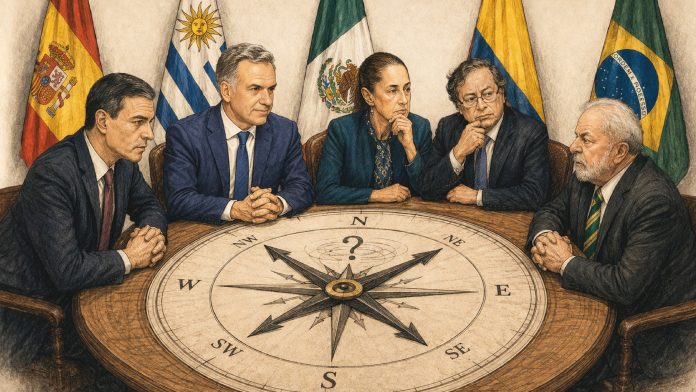
Capitalizing on the momentum, the left seems to have realized that things have to change, both in terms of rhetoric and of actions. That is why Spanish Prime Minister Pedro Sánchez—precisely one of the world leaders who has confronted Trump most directly—convened the fourth progressive summit in Barcelona. Several Latin American leaders became the stars of the meeting, and were treated as the highest-level guests. Among them were Mexico’s Claudia Sheinbaum, Brazil’s Lula da Silva, Colombia’s Gustavo Petro, Uruguay’s Yamandú Orsi, and former Chilean President Gabriel Boric.
Steven Forti, academic at the Autonomous University of Barcelona and author of the book Extrema derecha 2.0: Qué es y cómo combatirla, highlights the twist of fate that caused the meeting to take place less than a week after Orbán’s defeat. He says that, speeches and photos aside, this circumstance underlined the left’s concrete attempt to reorganize itself “with proposals in favor of democracy, against authoritarianism, and against the techno-oligarchs.” But, he stresses, “we’ll see if it’s truly a turning point or just a parenthesis.”
The fact is that in Barcelona, some remarks led to believe this renewal and reassessment that progressivism is undergoing. “Democracy is not a natural state of affairs. We have to take care of it; it is fragile,” Boric said. The former Chilean president just experienced a crushing defeat of his center-left coalition, which also paved the way for a Trump ally: the ultra-conservative José Antonio Kast.
🔴 DIRECTO | Gabriel Boric, en la cumbre progresista: “Hay una desafección hacia el derecho internacional y humanitario. La democracia no es un estado natural de las cosas, tenemos que cultivarla día a día” https://t.co/5U7iAyxgvD pic.twitter.com/DNyXqKzynn
— elDiario.es (@eldiarioes) April 18, 2026
In the meantime, even though Lula da Silva stated that the meeting was not “anti-Trump,” he took several jabs at the mogul. “We can’t wake up every morning and go to sleep every night with a tweet from the president of the republic threatening the world and declaring wars,” he said.
Felipe Enero Segovia, analyst of policies and international affairs at Universidad de Santiago de Chile, wrote in a column for the outlet Cooperativa that Barcelona was “a laboratory for progressive renewal.” For Enero, the summit was a turning point from a reactive stance toward Trump and his local counterparts to the formulation of a new agenda. The goal is to “rebuild the international order, strengthen liberal democracy, revive economic growth, and reduce inequality.”
Among the topics discussed was, for example, the role of digital platforms, a fertile ground for populism and polarization. Social media platforms allowed the far right to win over many voters in a context where progressive governments failed to fulfill promises to improve living conditions, particularly for the middle class. Especially the youngest, who are paying the price of unemployment and housing shortages despite having the highest level of education in history. Pedro Sánchez stated at the meeting that “the internet knows no borders, and therefore, either we move forward together or no one will move forward. Either we set common rules or they will be imposed on us, because the digital space is either democratic or it won’t be.”
In his column entitled “Optimismo progresista y letra muerta” published in El País, analyst Alfredo Joignant acknowledges that the Barcelona summit was held at the ideal moment: “The combination of a Trump in disarray, Pedro Sánchez’s notable prominence on the international stage, and the end of Orbán’s reign made it possible for a spirit of optimism to emerge within global progressivism for the first time in many years.”
For Joignant, one of the summit’s greatest victories is reclaiming the very concept of “progressivism,” which had become a bad word. He warns that left-wing discourse “was turning into a dead language, a bit like Latin, cited only by scholars and not by living people, where the repetition of formulas and words sounds increasingly outdated, detached from reality, with no chance of resonating with the common sense of real people.”
Mi columna de todos los lunes en @elpais_chile : “Optimismo progresista y lengua muerta” https://t.co/9yRqXJptQy
— Alfredo Joignant (@JoignantAlfredo) April 20, 2026
Brazil and Colombia are Playing Their own World Cup
This year will be crucial in determining whether progressive forces can retain governments to lead the majority of the population in Latin America. The first round of the presidential election will take place in Colombia on May 31, where leftist Iván Cepeda remains in the lead in the polls. And on October 4, it’s Brazil’s turn to vote in the first round of its presidential election. There, Lula da Silva is in a virtual tie with the son of former far-right president, Jair Bolsonaro. Colombia and Brazil have a combined population of 256 million, more than the rest of South America’s countries combined. In both nations, anti-American sentiment toward U.S. neo-imperialism in the Trump era could work in favor of left-wing candidates.
Brazilian journalist Víctor Farinelli, deputy editor of Opera-Mundi, argues that Lula inherited a Brazil that was economically “in shambles,” but managed to stabilize it. For Farinelli, a victory for the right in his country would be like a victory for “American autocracy, which is attempting to subjugate Latin America rather aggressively.”
For his part, Colombian analyst Javier Garay argues that domestic contexts carry the most weight for voters. “It seems—and this has been happening at least since the pandemic—that voters are tired of those in power at any given moment. And what does that mean? That societies today are not perceiving changes and developments from ideological perspectives, but from much more practical ones in terms of problem-solving,” he says.
The professor of International Relations at the Externado University notes that in the case of Colombia, for example, there is a sense of weariness among the population regarding Gustavo Petro, even though this month his approval rating reached its highest level since 2022 (46% approval according to calculations by La Silla Vacía).
In Barcelona, Petro attempted to stand out in interviews with his characteristic deep voice, full of grandiloquent phrases. “These days we are trying to build a kind of collective beacon in this city that will shed light on today’s world,” he said at a conference.
Garay argues that “what Petro is after is to become a leader of the Latin American left. I would even add a global leader of progressivism. However, does that necessarily mean he will become that? I don’t know, because I believe that Da Silva is the natural leader of the left in Latin America.”
Despite the tone of the Barcelona meeting, Sánchez did not invite authoritarian regimes yet they remain present in a complex scenario. In fact, upon returning to the continent, Petro traveled to Venezuela and became the first head of state from a democratic country to visit the dictator in charge of Chavismo, Delcy Rodríguez. Precisely the historical ties of the regional left with dictatorships also play against them when it comes to convincing more centrist voters. “Beyond Boric in Chile, who has been adamant in his defense of democracy, the other leaders lack transparency or outright support regimes like those in Venezuela, Cuba, and to a lesser extent Nicaragua (…) even Lula has been very close to them, not to mention Gustavo Petro,” says Garay.
Thus, during the Barcelona summit, Lula asserted: “We must put an end to this blockade of Cuba and let Cubans live their lives. We cannot remain silent in the face of this.” Mexican Claudia Scheinbaum made similar remarks: “To date, referring to that small Caribbean island—we think no people are small, but rather great and stoic when defending their sovereignty and the right to a full life.” There were no words against the regime’s authoritarianism despite the fact that the forum was titled “In Defense of Democracy.”
Farinelli defends these stances. “No one is asking right-wing governments to distance themselves from autocratic governments like the United States and Argentina, for example,” he says. He also asks that the context be taken into account: “Cuba is threatened by an American military attack, which has even been announced by Trump in those terms (…) in the face of that situation, not only countries governed by the left, but also by the right, have shown solidarity.”
In the case of Venezuela, he explains that the United States itself normalized its relations. And as for Nicaragua, “I don’t know of any left-wing government in the region that unconditionally defends the Ortega government. Beyond the relations one must maintain with a country, complete isolation ends up punishing the people rather than the government,” argues Farinelli.
“Paren ese maldito bloqueo a Cuba y dejen que los cubanos vivan sus vidas”, dice Lula en la cumbre progresista de Barcelona, al lado de Sánchez. “Cuba tiene problemas, pero son los problemas de los cubanos. No de Lula, de Claudia o de Trump”, afirma sobre la soberanía de la isla pic.twitter.com/UU2rIoiAF3
— Juan Manuel Karg (@jmkarg) April 18, 2026
Leadership and Principles
Steven Forti also argues that, in an outlook of severely weakened parties, politics has become “hyper-personalized.” “A strong leader who knows how to communicate effectively works best, and that explains the success of figures like Pedro Sánchez or New York City Mayor Zohan Mamdani,” Forti asserts. He adds, however, that for progressivism to succeed, it is essential “to have a strong regional base and to be present in the struggles.”
In that regard, he asserts that the progressive left has taken a defensive stance in recent years and that it has been “fearful of what is happening in the world. But it must regain political initiative, understanding that while the context is indeed very complex, there are opportunities to change course and to capitalize on this potential turning point.”
The academic acknowledges that the far right has been able to recognize the demands of a large portion of citizens. To this end, Forti asserts that progressivism must focus on “bold social policies that reduce inequalities and that take into account the working class, informal workers, and the middle class alike.”
Over the past decade, the battles of the progressive left have been associated with identity-based causes, such as feminism, LGBTI rights, and indigenous rights. Meanwhile, the far right has appropriated the anti-elite discourse (Milei called it “the caste”) and has even become “proud” of sexist, anti-democratic, or intolerant stances. As if barbarism were “popular.”
So should the progressive left renounce its principles to win at the polls? Philosopher Pau Luque Sánchez, a professor at Universidad Autónoma de México, writes in his column “La vergüenza, la izquierda y Trump” that the problem is not in the ideas, but in the way they are being defended. “When I read that the left should be more anti-immigration or less feminist, I feel like jumping out the window. The left doesn’t have to change its ideas; it has to change its attitude. It must abandon the moral arrogance with which it defends its ideas. And it must stop trying to shame others for not sharing its ideas.” Will it succeed?