Techno-Feudalism Sets its Sights on Latin America

By Leonardo Oliva

What do the military intelligence that led to the death of Osama Bin Laden, the data analysis software used by the Ferrari Formula 1 team, the aircraft design of the giant Airbus, the ICE system for tracking and monitoring suspected illegal immigrants, the smart sensors in Panasonic factories, and the lethal drones that the United States has deployed in the Middle East have in common? Behind all this technology is Palantir, the company that has become one of the Pentagon and CIA’s main contractors under the Donald Trump administration.

And it is no coincidence. One of its founders, tycoon Peter Thiel, was a key financier of the Republican’s first presidential campaign in 2016. Now, Palantir is the “brain” of the American government’s military intelligence and security offensive against its internal and external enemies. Its influence has been seen in Venezuela and the Caribbean waters, in Iran, and elsewhere where Washington’s interests are at stake.

But Thiel’s tentacles reach much further. He recently arrived in Buenos Aires, where he purchased a $12 million mansion and met with President Javier Milei at Casa Rosada. Very few details of that meeting have emerged. It was only reported that they discussed potential agreements between the Argentinian government and the businessman regarding surveillance and security technologies, as well as energy investments.

🤝Javier Milei, junto a Pablo Quirno, recibió al empresario Peter Thiel en Casa Rosada

➡Se trata del cofundador de PayPal y Palantir Technologies, que analiza inversiones en Inteligencia Artificial, defensa y energía. La reunión tiene el fin de venderle al Estado sus sistemas… pic.twitter.com/o4se2wTzGh

— El Observador Argentina (@observadorar) April 23, 2026

This is not Thiel’s first venture in Latin America. As reported by CONNECTAS, Palantir is already in talks with Ecuador’s Customs Agency to integrate its data analysis software for mass surveillance at the country’s borders. Additionally, the German-born entrepreneur is one of the investors of Próspera, an enclave for millionaires on the coast of Honduras that aims to be the “most developed startup city in the world”. A Silicon Valley outpost in Central America that includes El Salvador, where Nayib Bukele has decided to hand over the country’s public health management to Google’s AI.

Thiel has consolidated a business empire based on his entrepreneurial vision (he founded PayPal and invested in the first version of Facebook) and his unique ideology, made up in equal parts by Catholicism, libertarianism, and militarism. That, plus controversial statements such as those about the Antichrist, have turned him into a sort of supervillain in the eyes of a segment of society, even more so than his former partner and fellow adventurer Elon Musk.

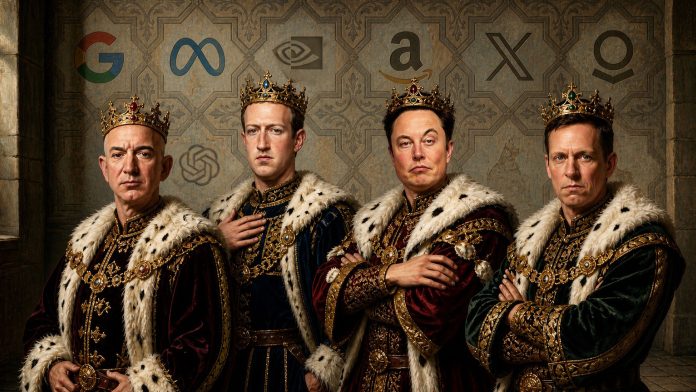
Both share the DNA of techno-feudalism, a concept coined by Greek economist Yanis Varoufakis to describe how tech magnates are reshaping the capitalist system and, with it, democracy. Thiel, Musk, and others like Mark Zuckerberg (Meta), Jeff Bezos (Amazon), Sam Altman (OpenAI), Jensen Huang (Nvidia), and Larry Ellison (Oracle) now orbit government policies due to their billions of dollars, but above all, because of the power granted to them by data of individuals collected through their technology platforms.

In late April, seven of these companies—SpaceX, OpenAI, Google, Nvidia, Reflection, Microsoft, and Amazon—agreed to sell the use of their artificial intelligence technologies to American military networks. “Access to a wide range of AI capabilities from across the U.S. technology ecosystem will provide warfighters with the tools they need to act with confidence and protect the nation against any threat,” a Pentagon spokesperson stated.

The irony is that, just as they use the state to make money, many of these tech entrepreneurs advocate for shrinking the size of that very same state to “free” people from government control. And some, such as Thiel himself and his partner at Palantir, Alex Karp, argue that in the new war that—according to them—the West is waging against its current enemies—China, Islam, and the globalist left—the key weapon for victory will not be democracy but technology.

“Techno-feudalism is a somewhat vague concept,” says Tomás Borovinsky, an Argentinian intellectual who has studied this phenomenon. “It is not very satisfying to argue that today we no longer live under capitalism but under techno-feudalism, which would be like another mode of production. It is true, however, that some political ideas are techno-feudal. That is, they are pro-modernity, pro-technology but anti-Enlightenment, with a highly critical view of democratic equality—an unequal, hierarchical perspective in which technology plays a fundamental role,” he explains in an interview with CONNECTAS.

Many of these controversial ideas highlighted by Borovinsky appear in the recent manifesto published by Palantir, which summarizes the central ideas of Alex Karp’s book The Technological Republic. There we find irredentism (“The elite of Silicon Valley engineers has an obligation to participate in the defense of the nation”), techno-militarism (“The question is not whether weapons will be built with artificial intelligence, but who will build them and for what purpose”), libertarianism (“Public officials need not be our priests”), religiosity (“We must resist the widespread intolerance toward religious beliefs in certain circles”), and even racism (“Some cultures have made fundamental progress; others remain dysfunctional and backward”).

Because we get asked a lot.

The Technological Republic, in brief.

1. Silicon Valley owes a moral debt to the country that made its rise possible. The engineering elite of Silicon Valley has an affirmative obligation to participate in the defense of the nation.

2. We must rebel…

— Palantir (@PalantirTech) April 18, 2026

There is another premise in the manifesto that went largely unnoticed but deserves attention: “It takes more than a moral appeal” for democracy to function. In Silicon Valley parlance, democracy is just another piece of software that needs to be maintained and updated so that societies will believe in it again. In that sense, Sam Altman himself responded four days later to Palantir with his own manifesto, in which he asserts that his technology seeks “universal prosperity” or the “resilience” of people.

For Borovinsky, these tech magnates see that democracy cannot solve the challenges posed by the Cold War between the United States and China due to “its checks and balances, and its separation of powers.” Thus, people like Peter Thiel or right-wing intellectuals Nick Land and Curtis Yarvin wonder whether China has, in its own way, a more effective formula for technological innovation and development—one that is neither democratic nor liberal.

This questioning of democratic values has led to an even more extreme concept: “techno-fascism.” In contrast, pro-technology intellectuals speak of “liberatory accelerationism” instead, a sort of techno-positivism that asserts that technological innovation (based on AI) will lead to the rapid development of our societies.

And all this innovation would have a “new White House,” based in Silicon Valley. A place well known to entrepreneur Santiago Siri, author of the book Tecnosapiens. For him, behind characters like Thiel, with their villainous image, “there’s something of a Marvel movie narrative,” justified by their enormous power, since “they’re the kind of people who collect data on millions of people, influence governments, and finance policies.”

Siri explains to CONNECTAS that “demonizing them oversimplifies the issue. They aren’t caricatures; many of the things they do work, and in that sense, they generate real value. They aren’t gods, but they aren’t irrelevant either. And they’re in a unique position: they’re a kind of new class with capital, technology, and narrative—a combination that’s both very powerful and unprecedented in history.” That’s why, for this expert, “whether they’re good or bad is besides the point, but rather what kind of world they’re helping to build—and, in any case, who regulates them. Because if there’s no answer to that, it’s power without checks and balances.”

Just as Palantir provides the technology that turns the American government into a powerful Big Brother, and SpaceX develops the rockets that will take NASA astronauts to Mars, there is another company that has become a strategic weapon in this battle: Anthropic. Its artificial intelligence software, Claude, allowed Washington to capture Nicolás Maduro in Caracas. And although it later refused to support the Pentagon in the war against Iran, today it is the highest-valued company in the AI ecosystem. Its new model, Mythos, is so powerful that the company decided to restrict its access to the general public due to its ability to penetrate any computer system, public or private.

All of this requires vast amounts of energy, and that’s where Latin America plays a key role for these tech billionaires. While Anthropic CEO and founder Dario Amodei was visiting the White House on April 17, executives from his company were in Buenos Aires and São Paulo. “These companies need a lot of energy, and they see Argentina, Brazil, and the region as a source to provide it,” one of the organizers of those visits told Bloomberg. Borovinsky agrees: “Latin America is an interesting place because of its natural resources, mainly its mining, its energy, its rare earths, and its food production.”

But that’s not all. The Argentinian researcher points to another interest of techno-feudalism in our region, one that often goes unnoticed: The Tech Exit, a strategy through which Silicon Valley tycoons seek to create enclaves isolated from the rest of society, far from state controls, such as Próspera in Honduras. And even further, some have purchased land in the Southern Cone to build bunkers where they can take shelter from the nuclear wars threatening the Northern Hemisphere. Paranoia or apocalyptic foresight?

Etiquetas:

Techno-Feudalism Sets its Sights on Latin America

By Leonardo Oliva

What do the military intelligence that led to the death of Osama Bin Laden, the data analysis software used by the Ferrari Formula 1 team, the aircraft design of the giant Airbus, the ICE system for tracking and monitoring suspected illegal immigrants, the smart sensors in Panasonic factories, and the lethal drones that the United States has deployed in the Middle East have in common? Behind all this technology is Palantir, the company that has become one of the Pentagon and CIA’s main contractors under the Donald Trump administration.

And it is no coincidence. One of its founders, tycoon Peter Thiel, was a key financier of the Republican’s first presidential campaign in 2016. Now, Palantir is the “brain” of the American government’s military intelligence and security offensive against its internal and external enemies. Its influence has been seen in Venezuela and the Caribbean waters, in Iran, and elsewhere where Washington’s interests are at stake.

But Thiel’s tentacles reach much further. He recently arrived in Buenos Aires, where he purchased a $12 million mansion and met with President Javier Milei at Casa Rosada. Very few details of that meeting have emerged. It was only reported that they discussed potential agreements between the Argentinian government and the businessman regarding surveillance and security technologies, as well as energy investments.

🤝Javier Milei, junto a Pablo Quirno, recibió al empresario Peter Thiel en Casa Rosada

➡Se trata del cofundador de PayPal y Palantir Technologies, que analiza inversiones en Inteligencia Artificial, defensa y energía. La reunión tiene el fin de venderle al Estado sus sistemas… pic.twitter.com/o4se2wTzGh

— El Observador Argentina (@observadorar) April 23, 2026

This is not Thiel’s first venture in Latin America. As reported by CONNECTAS, Palantir is already in talks with Ecuador’s Customs Agency to integrate its data analysis software for mass surveillance at the country’s borders. Additionally, the German-born entrepreneur is one of the investors of Próspera, an enclave for millionaires on the coast of Honduras that aims to be the “most developed startup city in the world”. A Silicon Valley outpost in Central America that includes El Salvador, where Nayib Bukele has decided to hand over the country’s public health management to Google’s AI.

Thiel has consolidated a business empire based on his entrepreneurial vision (he founded PayPal and invested in the first version of Facebook) and his unique ideology, made up in equal parts by Catholicism, libertarianism, and militarism. That, plus controversial statements such as those about the Antichrist, have turned him into a sort of supervillain in the eyes of a segment of society, even more so than his former partner and fellow adventurer Elon Musk.

Both share the DNA of techno-feudalism, a concept coined by Greek economist Yanis Varoufakis to describe how tech magnates are reshaping the capitalist system and, with it, democracy. Thiel, Musk, and others like Mark Zuckerberg (Meta), Jeff Bezos (Amazon), Sam Altman (OpenAI), Jensen Huang (Nvidia), and Larry Ellison (Oracle) now orbit government policies due to their billions of dollars, but above all, because of the power granted to them by data of individuals collected through their technology platforms.

In late April, seven of these companies—SpaceX, OpenAI, Google, Nvidia, Reflection, Microsoft, and Amazon—agreed to sell the use of their artificial intelligence technologies to American military networks. “Access to a wide range of AI capabilities from across the U.S. technology ecosystem will provide warfighters with the tools they need to act with confidence and protect the nation against any threat,” a Pentagon spokesperson stated.

The irony is that, just as they use the state to make money, many of these tech entrepreneurs advocate for shrinking the size of that very same state to “free” people from government control. And some, such as Thiel himself and his partner at Palantir, Alex Karp, argue that in the new war that—according to them—the West is waging against its current enemies—China, Islam, and the globalist left—the key weapon for victory will not be democracy but technology.

“Techno-feudalism is a somewhat vague concept,” says Tomás Borovinsky, an Argentinian intellectual who has studied this phenomenon. “It is not very satisfying to argue that today we no longer live under capitalism but under techno-feudalism, which would be like another mode of production. It is true, however, that some political ideas are techno-feudal. That is, they are pro-modernity, pro-technology but anti-Enlightenment, with a highly critical view of democratic equality—an unequal, hierarchical perspective in which technology plays a fundamental role,” he explains in an interview with CONNECTAS.

Many of these controversial ideas highlighted by Borovinsky appear in the recent manifesto published by Palantir, which summarizes the central ideas of Alex Karp’s book The Technological Republic. There we find irredentism (“The elite of Silicon Valley engineers has an obligation to participate in the defense of the nation”), techno-militarism (“The question is not whether weapons will be built with artificial intelligence, but who will build them and for what purpose”), libertarianism (“Public officials need not be our priests”), religiosity (“We must resist the widespread intolerance toward religious beliefs in certain circles”), and even racism (“Some cultures have made fundamental progress; others remain dysfunctional and backward”).

Because we get asked a lot.

The Technological Republic, in brief.

1. Silicon Valley owes a moral debt to the country that made its rise possible. The engineering elite of Silicon Valley has an affirmative obligation to participate in the defense of the nation.

2. We must rebel…

— Palantir (@PalantirTech) April 18, 2026

There is another premise in the manifesto that went largely unnoticed but deserves attention: “It takes more than a moral appeal” for democracy to function. In Silicon Valley parlance, democracy is just another piece of software that needs to be maintained and updated so that societies will believe in it again. In that sense, Sam Altman himself responded four days later to Palantir with his own manifesto, in which he asserts that his technology seeks “universal prosperity” or the “resilience” of people.

For Borovinsky, these tech magnates see that democracy cannot solve the challenges posed by the Cold War between the United States and China due to “its checks and balances, and its separation of powers.” Thus, people like Peter Thiel or right-wing intellectuals Nick Land and Curtis Yarvin wonder whether China has, in its own way, a more effective formula for technological innovation and development—one that is neither democratic nor liberal.

This questioning of democratic values has led to an even more extreme concept: “techno-fascism.” In contrast, pro-technology intellectuals speak of “liberatory accelerationism” instead, a sort of techno-positivism that asserts that technological innovation (based on AI) will lead to the rapid development of our societies.

And all this innovation would have a “new White House,” based in Silicon Valley. A place well known to entrepreneur Santiago Siri, author of the book Tecnosapiens. For him, behind characters like Thiel, with their villainous image, “there’s something of a Marvel movie narrative,” justified by their enormous power, since “they’re the kind of people who collect data on millions of people, influence governments, and finance policies.”

Siri explains to CONNECTAS that “demonizing them oversimplifies the issue. They aren’t caricatures; many of the things they do work, and in that sense, they generate real value. They aren’t gods, but they aren’t irrelevant either. And they’re in a unique position: they’re a kind of new class with capital, technology, and narrative—a combination that’s both very powerful and unprecedented in history.” That’s why, for this expert, “whether they’re good or bad is besides the point, but rather what kind of world they’re helping to build—and, in any case, who regulates them. Because if there’s no answer to that, it’s power without checks and balances.”

Just as Palantir provides the technology that turns the American government into a powerful Big Brother, and SpaceX develops the rockets that will take NASA astronauts to Mars, there is another company that has become a strategic weapon in this battle: Anthropic. Its artificial intelligence software, Claude, allowed Washington to capture Nicolás Maduro in Caracas. And although it later refused to support the Pentagon in the war against Iran, today it is the highest-valued company in the AI ecosystem. Its new model, Mythos, is so powerful that the company decided to restrict its access to the general public due to its ability to penetrate any computer system, public or private.

All of this requires vast amounts of energy, and that’s where Latin America plays a key role for these tech billionaires. While Anthropic CEO and founder Dario Amodei was visiting the White House on April 17, executives from his company were in Buenos Aires and São Paulo. “These companies need a lot of energy, and they see Argentina, Brazil, and the region as a source to provide it,” one of the organizers of those visits told Bloomberg. Borovinsky agrees: “Latin America is an interesting place because of its natural resources, mainly its mining, its energy, its rare earths, and its food production.”

But that’s not all. The Argentinian researcher points to another interest of techno-feudalism in our region, one that often goes unnoticed: The Tech Exit, a strategy through which Silicon Valley tycoons seek to create enclaves isolated from the rest of society, far from state controls, such as Próspera in Honduras. And even further, some have purchased land in the Southern Cone to build bunkers where they can take shelter from the nuclear wars threatening the Northern Hemisphere. Paranoia or apocalyptic foresight?

Etiquetas: