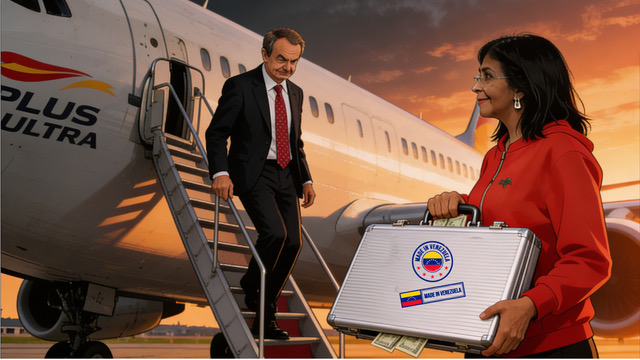
Spanish justice had been circling Rodríguez Zapatero’s inner circle for months. But only when formal charges landed did the Spanish left truly reckon with what was before it. The disbelief gave way to an uncomfortable question: had the former president quietly lobbied the government to funnel a multimillion-euro bailout to Plus Ultra, a Venezuelan-backed airline?
Fellow coalition member Gabriel Rufián put it without ceremony when he turned on Prime Minister Pedro Sánchez: “Where does lobbying end and influence-peddling begin? If true, it’s a disgrace. If false, it’s a bigger one—and it deserves an answer.”
The shockwaves have crossed the Atlantic. The case reopens a stubborn question about the relationship between Spain’s progressive figures and the region’s authoritarian governments. Former presidents, judges, party founders, and parliamentary deputies have spent years mediating, advising, and quietly orbiting left-wing regimes in ways that have never been fully transparent.
For political analyst Francisco Sánchez, these actors see in the Latin American left an epic quality that has fueled historic processes, such as the Cuban Revolution, Mexico’s Zapatismo and Venezuelan Chavismo. “It taps into something deep,” he says. “The New World. The utopia of the new man.”
Yet, as scholar Fernando Pedrosa argues in Diálogo Político, certain Latin American left-wing movements routinely justify power grabs, weakened institutions, and creeping authoritarianism as necessary costs of social justice and anti-imperialism. Their Spanish counterparts, it seems, have been willing to agree.
Old and New Acquaintances
The story predates Zapatero. Former magistrate Baltasar Garzón offers perhaps the clearest arc. His Latin American engagement began creditably enough, when he issued an international arrest warrant against Chile’s Augusto Pinochet in the late 1990s. He also pursued legal action against unpunished figures from Argentina’s military dictatorship.
Later, riding the “pink tide” of the 2000s, Garzón advised Rafael Correa’s overhaul of Ecuador’s judiciary in 2012 and 2013—a reform the opposition denounced as the politicisation of the bench dressed up as modernisation. He had earlier consulted on a similar project for Bolivia’s Evo Morales, and later defended Morales legally against sedition charges after his resignation.
Then came murkier waters. In 2016, Garzón signed a lucrative contract with PDVSA, Venezuela’s state oil company, to allegedly smooth the firm’s path through Spanish courts and prosecutors’ offices. He later defended Alex Saab, the Colombian businessman widely regarded as Nicolás Maduro’s front man, when Saab was first detained in Cape Verde. More recently, he championed the cause of Argentina’s Cristina Kirchner, framing her six-year corruption conviction as lawfare.
Left-wing political party Podemos traced a similar trajectory. Co-founder Juan Carlos Monedero was in Caracas as early as 2005, working at the Centro Internacional Miranda—the think tank that engineered Hugo Chávez’s “21st-century socialism.” He broke with the project in 2010 but never fully departed the region, cycling through Bolivia, Nicaragua, and eventually back to Venezuela, where he advised Maduro and defended the disputed 2024 elections. He delivered a lecture on human rights at El Helicoide—a detention facility where international monitors have documented systematic torture of political prisoners.
Leaders of Podemos and Sumar have seen the region as a political space in which to rehearse their left-wing rhetoric. Pablo Iglesias runs a television channel and digital outlet in Mexico. Deputy Enrique Santiago —legal representative of Cuban state enterprises in Spain—played a back-channel role in the Colombian government’s negotiations with the Marxist guerrilla FARC, and has more recently maintained ties with Gustavo Petro’s administration, advising the ruling party’s presidential candidate, Iván Cepeda.
Analyst Sánchez notes that these political actors adopt a colonialist attitude and view the region through the lens of the utopia of change: “It should not be seen merely as a presence, but as an extension of Spanish foreign policy toward these countries.”
The Lines That Were Never Drawn
Zapatero’s presence in Venezuela began innocuously over a decade ago—conference circuit appearances, business summits and bland diplomacy. He later positioned himself as a mediator in Venezuela’s political crisis, a role the opposition never truly accepted. In 2018, opposition leader María Corina Machado was blunt: “He comes here to deal with someone, but not with us. He comes to blame U.S. sanctions for the exodus [of Venezuelans]. It’s four years of deception with a so-called dialogue that isn’t one.”
Sánchez concurs. “He was never a neutral broker. He validated the Maduro-Chávez regime and if you want to mediate you have to be capable of recognizing that the opposition holds a certain legitimacy.”
Zapatero himself, in an interview this past March, described Venezuela’s acting president Delcy Rodríguez and her brother Jorge, the parliamentary speaker, as personal friends. “I know very well what they do, what they have done, how they have supported me in these tasks of freeing prisoners, and of course I am going to defend that friendship,” he replied when asked whether he was unbothered by having such a relationship with two people who lead a repressive regime.
The charges, however, are not about his friendships. They concern what allegedly came next: a coordinated effort to steer a €53 million state pandemic-relief loan toward Plus Ultra — an airline owned by Venezuelan shareholders with government ties, the so-called boliburgueses. The opposition argues that this was a strategic government fund, hardly applicable to an airline as insignificant as that one. Spanish prosecutors now suggest Zapatero made it happen—and that a web of shell companies, allegedly involving his own daughters, was used to launder the proceeds.
As Sánchez puts it, Zapatero went all-in on the Venezuelan regime from the start. He never drew any ethical limits or legal lines. The problem is that, beyond his responsibility in the alleged influence-peddling case, harm was done. “He allegedly took sides, and that became a network of favors that clearly conveys the idea that this is a dishonest left, just as corrupt as the others—a left that continues to view Latin America through a colonial lens,” he explained.
His case holds up an unflattering mirror—reflecting both the authoritarian regimes that court international legitimacy wherever they can find it, and a Spanish political culture in which, as Rufián asked from the parliament’s floor, nobody can quite say where lobbying ends and corruption begins.