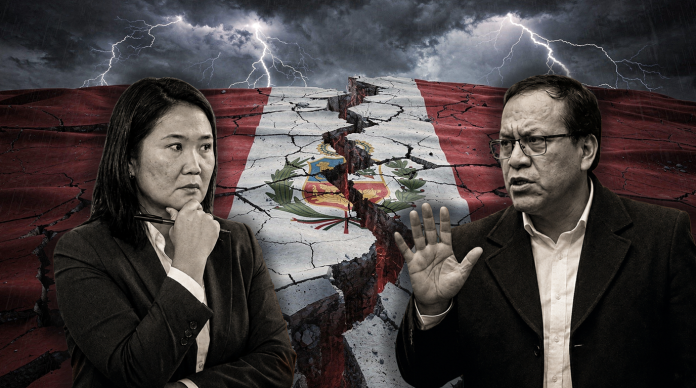
After one of the most consequential elections in its history, Peru still doesn’t know who its next president will be. The razor-thin margin between leftist Roberto Sánchez and right-wing candidate Keiko Fujimori means the suspense won’t lift until every vote is counted and every official record reviewed.
Peru’s electoral authority handles vote tallying but cannot proclaim the winner—that power belongs exclusively to the National Elections Jury (JNE). The JNE is not expected to issue its ruling until mid-July, once it resolves thousands of challenges and objections that could stretch the process for weeks.
The rest of the region is watching closely. The country’s ninth president in just ten years will be a key figure in Latin America’s political realignment, at a moment when the left appears to be searching for itself, and with decisive elections still ahead in Colombia and Brazil.
Keiko Fujimori is perhaps the most constant figure in Peruvian politics. Running for the fourth time as the candidate of Acción Popular, she carries the weight of her father Alberto Fujimori’s legacy—a presidency from 1990 to 2000 that still divides the country. His supporters point to the defeat of Sendero Luminoso and the foundations he laid for economic stabilization. His critics cite authoritarianism, rampant corruption, human rights violations, and the near-total dismantling of democratic institutions.
These opposing views have shaped generations and defined Peruvian politics around the very concept of fujimorismo. Keiko leans into that history with a tough-on-crime platform and the slogan “Fujimori is back, order is back.” “Intelligence defeated terrorism and we will use it again to defeat crime,” she said during the campaign, staking her candidacy on national pacification.
On the other side, leftist Roberto Sánchez of Juntos por el Perú entered the race with starkly different ideas. The 57-year-old congressman — nicknamed “heir to the hat,” a direct reference to imprisoned former president Pedro Castillo, who was jailed for attempting a coup d’état — led a crowded first round with sharp anti-capitalist rhetoric and a call for a constitutional referendum. But heading into the runoff, he moderated his message to build strategic alliances, pledging to protect macroeconomic stability, respect the independence of the Central Reserve Bank, and honor free trade agreements. His goal is clear: defeat “the lady of chaos,” as he calls Fujimori.
These aren’t merely opposing options—either one risks another leap into the void. On that much, there is certainty: the country’s political fragmentation and deep polarization will make governing a nightmare for whoever wins. Nadia Ramos, a multilateralism specialist and electoral observer, believes Fujimori would have a governing advantage and a better chance of lasting five years, given her parliamentary majority.
“I feel that both candidates will have the legality of being president, but not the legitimacy to govern a country as ungovernable as Peru,” Ramos said. “And this isn’t new—the problem has always been there. It’s not their fault, but both of them polarize and deepen the sense that things aren’t going to be resolved the way we’d want.”
Starting this year, Peru will also have a bicameral parliament—a reform aimed at blocking votes to remove the president and raising the quality of political debate. But it poses its own challenges given the deep fragmentation of the party system and the country’s identity-based divisions.
Governing Under Siege
Peru’s predicament is not unique. Seven months ago, Rodrigo Paz took office in Bolivia after a surprise electoral win, promising a new direction and a renewed relationship with the international community. The ideological shift was enormous: nearly two decades of left-wing hegemony under presidents Evo Morales and Luis Arce, sustained by powerful social movements, had just ended.
Today, Paz is engulfed in social unrest that has paralyzed the country and left at least ten people dead. The situation is most acute in La Paz, where radical blockades on inter-departmental roads, marches that have turned violent, and fuel, food and medicine shortages have brought daily life to a halt. More than 40 days in, protests have spread to other regions as government dialogue efforts have failed repeatedly—fueled partly by union leaders and by former president Morales himself, who is demanding new elections within 90 days.
The problem is that the conflict involves multiple sectors with competing demands, which makes any agreement harder to reach. What began as specific grievances — wage increases, public-sector jobs, better living conditions — has curdled into calls for the president’s resignation. Political scientist Ana Lucía Velasco puts it plainly: “Governance is not a magic formula in political science where a government comes in, and everyone falls in line. It depends on the level of social capital—how much people trust each other and how willing they are to work together.” For Morales, there is no solution other than Paz stepping down.
The facts tell a stark story: Paz won the government but not the power. He still believes he can negotiate his way through to 2030, and points to what he calls a “narco-terrorist” movement as the source of the unrest.
For Marcela Ríos Tobar, director of International IDEA for Latin America and the Caribbean, the dynamic follows a familiar pattern: “Electoral support is not necessarily structural, social, or organic—and there are no solid parties to intermediate between society and power. That’s why governments weaken quickly when campaign promises go unfulfilled.”
She adds, however, that protest and mobilization are legitimate in consolidated democracies and some societies have them as a tradition. But “guaranteeing governance requires activating effective channels for dialogue with society.”
That same pressure is now playing out in Chile, where thousands of students, unions, and social organizations have taken to the streets in recent weeks to protest budget cuts in health, education, security, and public works—austerity measures imposed by President José Antonio Kast to stimulate private investment.
Just three months into office, having succeeded leftist Gabriel Boric, the far-right Kast has been caught in a storm of confrontations that forced him to remove his security minister and official spokesperson under pressure from protesters, the opposition, and even members of his own party. With dozens arrested, injuries reported, and accusations of excessive force, Kast is defending his economic program while cracking down harder on what he calls “incivility.”
Bolivia and Chile make the same point: political stability cannot be taken for granted after a legitimate electoral win. Presidents must govern polarized societies, with increasingly fragmented political systems and a backlog of unmet social demands. Colombia, heading into its own presidential runoff, makes the same case.
That country faces a pivotal moment. After Gustavo Petro — its first left-wing president — the fractures accumulated over decades of social and economic inequality are now sharper, exacerbated by the antagonism between the two frontrunners: far-right candidate Abelardo de la Espriella and Iván Cepeda, the pro-government candidate seeking to continue Petro’s project.
Colombian jurist Rodrigo Uprimny, a constitutional law specialist, argues that left-right conflict can be productive: “As long as there is consensus on basic rules of respect for the rule of law and democracy. That is what is being put at risk, because the idea has taken hold that if you win, you are my enemy. Or as De la Espriella puts it: ‘I’m going to gut the left.’ Or Cepeda, who won’t stop calling his opponent a fascist—with some justification. That is what polarization looks like.”
Yet Colombia has its own particular dynamics, Uprimny explains. The fracture is both social and territorial. “The peace agreement created a divide between those who supported it and those who didn’t, but it also brought out all the social issues that had been overshadowed by the war and by the security debate — and they erupted in a country that is profoundly unequal and discriminatory. That strengthened a left that had never been a significant political actor before.”
Petro’s resistance to accepting first-round results favorable to De la Espriella didn’t help the electoral climate, even though his own candidate eventually acknowledged them. Still, Ríos notes that “Colombia’s electoral system is robust, manual, traceable and transparent. International observers, party representatives, and citizens all participate as monitors of the process.”
What’s next for Colombia? Uprimny warns of enormous governance challenges for whoever wins, unless they can build an inclusive presidency. “Not just because Congress is fragmented, but because of the social and political division these elections have expressed and deepened. There is a need to build political and social agreements, with leadership from the church, business, and civic organizations playing a central role. Whoever becomes president will bear a fundamental responsibility in their attitude and their ability to forge the kind of agreements that Petro failed to reach, precisely because he preferred a politics of stigmatization and polarization.”
Polarization at the Service of Radicalism
According to the UN Development Programme’s recent report “Democracies Under Pressure,” Latin America is the most polarized region in the world. The UNDP’s polarization index places the continent at 3.4 — where 0 represents friendly coexistence between political actors and 4 represents extreme hostility — well above the global average of 2.9.
The region is home to four of the ten countries most affected by political violence. “The central challenge for democracies in Latin America and the Caribbean is ensuring that these tensions do not produce ruptures or violence, but can instead be channeled through institutional mechanisms,” the report states.
Polarization is not a new phenomenon, but it has been transformed, largely by the dynamics of social media and the amplification of hate speech. It is less ideological and more visceral, more emotional. Public debates have grown more confrontational, and spaces for consensus have narrowed. In this environment, elections tend to be framed as existential clashes between incompatible visions of the country, making any shared national project harder to build.
As the director of International IDEA puts it, politics is increasingly shaped by the idea that opponents are enemies, rather than simply people with different views. “There is an intent to smear, pursue, and destroy, and that weakens the way politics and institutions function—the capacity to reach agreements and design long-term public policy.”
Political scientist Ana Lucía Velasco is blunt about what radicalism does to governance. “I think leaders on the right, the left, and the far right are not offering a national project where everyone has a place. They’re offering an exit that says: ‘I’m proposing a country where the other side no longer exists.’ That is revenge and it will pull us into a cycle where, of course, there will be ungovernable states.”
Marcela Ríos Tobar frames the regional mood clearly: “I think Latin Americans still believe that living in a democracy is the ideal, but they have a deep distrust of how it actually works in their countries. That has to do with poor-quality politics, fragmentation, polarization, and persistent corruption scandals. It starts to erode faith in democracy, because people think: if there’s no difference, what’s the point? What we’re seeing globally is that while democracies don’t solve every problem, the alternatives are all worse.”
Beyond the marketing, the rhetorical force of candidates, and social media strategies — in a climate of political warfare, Latin America is demonstrating that winning the election is the easy part. The real challenge is having the political and institutional capacity to actually exercise power.