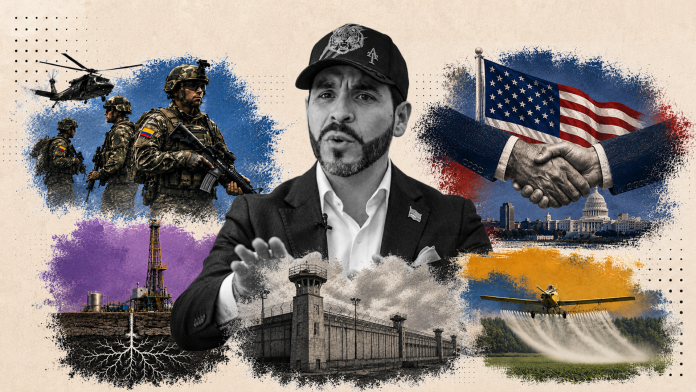
The Colombian runoff revealed a country split almost down the middle. De la Espriella’s narrow victory over Iván Cepeda, the Pacto Histórico candidate, creates a difficult governance environment that compounds the challenges the country already faces. His promise of “zero tolerance” — in the style of El Salvador’s Nayib Bukele — is built on restoring order and confronting organized crime, rising violence, and deteriorating urban security.
De la Espriella’s message is unambiguous: no tolerance for criminals, mega-prisons, and a militarized strategy to end the violence that flourished under outgoing president Gustavo Petro’s “Total Peace” policy. He also joins a growing bloc of Latin American leaders who not only share ideological common ground with Donald Trump but openly celebrate it.
“I am notifying drug traffickers, terrorists, kidnappers, extortionists, and corrupt officials who steal public resources that Colombia has a government and a state again. All those criminals will be relentlessly pursued within the framework of the Constitution and the laws of the republic. They will be hunted, captured, tried, and held accountable for every crime committed against our people and our nation—because true peace does not come from impunity. True peace comes from justice,” De la Espriella said after the initial results were announced.
The new president takes office on August 7 amid a complex landscape at home and across the hemisphere. Experts consulted by CONNECTAS say he will face a domestic terrain riddled with institutional and legal constraints that will limit his ambitions to govern in lockstep with Washington, though there will be high-profile strikes against organized crime. There is an additional factor: his close alignment with Trump will ultimately depend on whatever political shifts result from the U.S. congressional midterms in November.
Rhetorically, the De la Espriella project functions as a political satellite of U.S. power. Glaeldys González, an expert at the think tank International Crisis Group, notes his near-perfect alignment with the White House’s counter-narcotics priorities and its appetite for direct influence over regional politics. She expects cooperation on intelligence-sharing and active U.S. involvement in Colombia’s security strategy, including joint military operations on Colombian soil—as is already happening in Ecuador and with Venezuela. “We won’t necessarily see unilateral U.S. operations in Colombia. There could be some reluctance there, not just for legal reasons but because of the public backlash it could trigger,” she says.
Yet that alignment with Washington, which looks like an asset at first glance, may be De la Espriella’s greatest vulnerability. Luis Fernando Trejos, a professor at Universidad del Norte, acknowledges that U.S. political backing will become tangible once cooperation channels — broken under Petro — are restored. But he warns that De la Espriella also needs congressional support to push his security agenda. “You have to remember that in the United States, there are procedures that will have to go through Congress, and the magical result promised on the campaign trail — fixing the security crisis — is not going to happen that easily,” he says.
That uncertainty, political scientist Sandra Borda argues, poses a major question for an administration so closely tied to Trump. “Sometimes people lose sight of this. They say, ‘De la Espriella is going to have two great years because he’s close to the U.S. government and firmly in the MAGA camp’ and so on. The question is what happens after November, when the composition of Congress in the United States changes,” she notes.
The congressional appropriations committees are responsible for approving and channeling military aid to Colombia, and all signs point to the legislative pendulum swinging from Republican to Democrat.
Some experts, however, see a possible scenario where, even without much support from the U.S. Congress, De la Espriella could consolidate some regional leadership by exploiting the current right-wing momentum. Latin America is undergoing a profound shift, with strong leaders anchoring their security strategies in iron-fist politics: El Salvador’s Bukele, Ecuador’s Daniel Noboa, Argentina’s Javier Milei, Chile’s José Antonio Kast, and potentially Peru’s Keiko Fujimori. This regional landscape could give De la Espriella an ideological base that extends beyond the U.S. electoral cycle. “It will give him backing for whatever he wants to pursue in Colombia, regardless of who is in Washington,” González argues.
Troubles at home
Internally, the picture is far more intricate. De la Espriella has promised to immediately restore order through massive military operations targeting criminal leaders. For Gerson Arias, a researcher at the Fundación Ideas para la Paz (FIP), the strategy is a brilliant political shortcut with a high probability of short-term narrative success—but one that is structurally insufficient to resolve the armed conflict as it currently stands.
On the other side of the ledger are the steep costs — not just economic — of such operations. Arias points to social conflict, peasant resistance in coca-growing regions, and the humanitarian toll of militarized policy. For these reasons, he believes the long-term results of “zero tolerance” will be poor. The FIP researcher stresses that the coca economy runs deep in those communities, shaping livelihoods and social mobility. “If you shut that down, what you’ll encounter isn’t just mobilized peasants, it’s entire territories that believe money circulates because of coca. I’m not saying that’s right. I’m saying that, at the end of the day, it’s the harsh reality.”
El plan de Petro para sustituir los cultivos de coca no alcanza su objetivo
El presidente colombiano Gustavo Petro impulsó hace poco más de un año un programa de sustitución voluntaria de los cultivos ilícitos. El plan RenHacer quería erradicar 30.000 hectáreas, objetivo no… pic.twitter.com/ScPfUMH0kW
— DW Español (@dw_espanol) June 12, 2026
That coca economy has a darker dimension: the grip that armed groups hold over rural communities. Arias notes that criminal structures have evolved into more decentralized horizontal models and fighting them runs into hard operational obstacles, such as the state’s actual capacity. He adds that armed groups and FARC dissidents now operate low-cost, rudimentary drones that give them a meaningful defensive advantage against military raids.
Compounding this is the urgent need to rebuild Colombia’s security and defense investment, which Petro systematically hollowed out. Arias estimates that mobility, armaments, and ammunition capacity stand at just 46%, while nearly 40% of the air fleet is out of service. Given these conditions, Trejos argues that a massive military offensive would collide head-on with this reality, making it nearly impossible for De la Espriella to open seven or eight war fronts simultaneously without collapsing his own defense structures. He will have no choice but to prioritize.
#ATENCIÓN | Este es el poderoso arsenal de fusiles, drones y granadas que iba para el Guaviare para fortalecer a disidencias FARC de ‘Mordisco’. El cargamento fue incautado por el Ejército en el Valle del Cauca. Vía @josedavid88_https://t.co/R0kxQZ2KMp pic.twitter.com/mpxR0eRndg
— ÚltimaHoraCaracol (@UltimaHoraCR) June 22, 2026
Armed groups — both the ELN and FARC dissidents, as well as other criminal organizations — have mastered the art of filling the vacuum left by the Colombian state across vast stretches of territory. They do not rely solely on violence; they also apply direct pressure on local governments, including community associations, which have mobilized people to block roads or even detain soldiers on eradication operations.
In this environment, the question is how far De la Espriella will take his zero-tolerance policy. Borda predicts that the crackdown will lead to more imprisonments, lower tolerance for illegal activity, and — most dangerously — the use of force to retake territorial control. These outcomes carry serious risks: human rights violations and rising tensions with neighboring countries as criminal groups are pushed toward border zones.
Whatever the outcome, the success or failure of Abelardo de la Espriella’s administration will not be measured by the stridency of his rhetoric or by spectacular early enforcement operations. The real test will be his ability to move from his campaign narrative to the often disregarded grinding work of political and social governance. All the more so given his ideological alignment with Donald Trump — a dependency that could leave him hostage to the mood of a U.S. Congress that may look very different in a matter of months.
Trejos believes that, at its core, the metaphor of the stationary bicycle will define the new administration, as it has so many Colombian presidencies before it: “Some governments pedal harder than others, or sweat more than others—but the bicycle stays in the same place. A colossal effort with uncertain results.” Breaking that cycle will require surgical precision in a country now split in half to avoid deepening the wounds that violence has already opened.