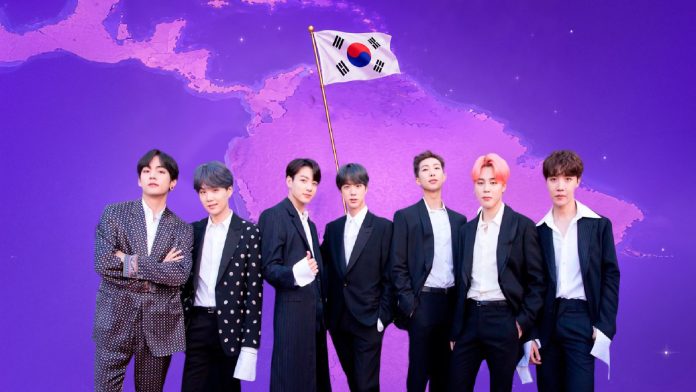
The scenes in Mexico were unprecedented. More than 50,000 people flocked to the Zócalo, in front of the National Palace, to greet the seven young Korean members of the group BTS. Two days later, more than 70,000 gathered around a stadium that was completely packed, while the group’s songs and the fans’ cheers echoed from inside.
Months earlier, thousands of fans—who call themselves ARMY worldwide (Adorable Representative M.C. for Youth)—protested on social media after being unable to secure tickets for the concerts in Mexico, which sold out in less than 40 minutes. In a move that some regard as empathy toward the BTS fandom and others as political opportunism, President Claudia Sheinbaum asked the group and the South Korean government to add more concert dates. In gratitude, upon their arrival in Mexico, BTS visited the president at the National Palace.
But what did the South Korean government have to do with scheduling more concert dates? BTS’s visit to Sheinbaum didn’t end there. A few days after the concerts, the country’s Senate reported on a diplomatic meeting held between the chair of Mexico’s Asia-Pacific Foreign Relations Committee, Yeidckol Polevnsky, South Korean Minister of Trade Yeo Han-Koo, and South Korean Ambassador to Mexico Jooll Lee.
The purpose of the meeting was “to strengthen cooperation in various areas.” Discussions focused primarily on trade in key sectors such as the automotive , electronics, and manufacturing industries, energy, and advanced technologies. “Mexico is South Korea’s main trading partner in Latin America and its tenth-largest globally,” the document states.
In addition, Sheinbaum herself spoke on the phone with her South Korean counterpart, Lee Jae Myung, to “further strengthen the excellent bilateral relationship and economic cooperation between the two countries.” An official statement noted that South Korea is one of Mexico’s main trading partners, with more than 2,000 Korean companies operating in the country.
In the book Corea del Sur y América Latina. Más allá del comercio, Richard Salazar writes that this Asian nation, which ranks among the twelve most powerful economies on the planet, “has become a global power.” This in spite of the fact that in 1953, at the end of the war that divided the peninsula, it was one of the poorest countries in the world. The researcher notes that its main focus was education “as a long-term investment, followed by research for innovation.”
Salazar says that in 1948, the country’s illiteracy rate was 78%, but “with support from the United States, they established a robust higher education system, which was inspired by the experience of the most prestigious American universities.” In the 1960s, they focused on industrializing the country for export and launched five-year development plans “that were rigorously implemented.”
Today, South Korea has the world’s highest percentage of gross domestic product (GDP) allocated to research and development (R&D). “It is a unique nation,” says Benjamin Min Han, a researcher at the University of Georgia. He explains that, although it is a small country that was colonized by Japan and endured several military dictatorships, it has managed to make rapid economic and technological progress. “It is a nation that epitomizes modernity.”
But since the late 1990s, Seoul has been promoting a project that went much further: boosting the cultural industry, not only as a means of spreading Korea’s presence around the world, but as another economic sector. Known as Hallyu, or the Korean Wave, this collaborative effort between the government and the private sector contributes significantly to GDP, with annual growth of up to 5%, according to an analysis by UNCTAD. “They planned and structured that industry to generate revenue,” explains Nayelli López, a scholar at UNAM who earned the first doctoral degree in Korean studies in Latin America.
In South Korea, “the private sector develops cultural products and works in tandem with the government’s interests to boost the economy. The government is contributing by redefining the country brand, which is the strategy for promoting Korea abroad,” López explains. For her, the thousands of people who gathered outside the National Palace and the stadium where BTS’s latest concert in Mexico took place are proof “of the impact of all those years of investment.”
Furthermore, the researcher believes that the fans’ dissatisfaction was not the only reason for the meeting between BTS and Sheinbaum. Behind it all were “the Republic of Korea’s significant and powerful interests in Mexico signing a free trade agreement with them.” Thus, it appears that BTS served as a gateway to speed up negotiations between the two countries at a crucial moment for Mexico. In fact, the USMCA, the free trade agreement it has with the United States and Canada, is currently being reviewed.
For some, the boy band is part of a South Korean government plan to open up markets around the world. This might be a new manifestation of soft power, a diplomatic strategy based on values and cultural initiatives. With BTS, “we see the government’s use of soft power,” López adds.
This is not something new. In fact, soft power played a key role in the East-West confrontation during the Cold War. One example was the cultural industry the United States built in Hollywood, through a star system that ultimately influenced the ideology and economy of many generations worldwide.
The Soviet Union also engaged in this practice for decades, exercising tight control over artistic expression. Furthermore, in the book Who Paid the Piper?: the CIA and the Cultural Cold War, historian Frances Stonor-Saunders describes how the United States, through the CIA, designed a model for funding intellectuals and artists—musicians, painters, dancers, and actors—with the aim of fostering appreciation for American culture and countering the anti-imperialist sentiment that the Soviets were promoting in Europe.
The South Korean case has other nuances. Min Han believes it is not entirely true that Hallyu is a project imposed from the highest levels of power. The network is more complex. “The government supports the Korean cultural industry because it understands how it can transform Korea’s image. But part of the phenomenon is due to the fans, the listeners, and the people who consume Korean content. It is not simply a top-down project,” he argues.
Government influence is exerted in many ways. For example, South Korea’s National Pension Service is a major shareholder in HYBE Corporation, the production company behind BTS. According to data from the magazine Expansión, this is part of a strategy to strengthen the pension fund for Korean workers.
The approach to Sheinbaum was no coincidence. Mexico, Peru, Argentina, Colombia, and Brazil are among the top 10 countries worldwide with the most BTS fans. At the same time, South Korea “has made a strong entry” into Latin American markets, Salazar notes. Chile, Peru, and Colombia have signed trade agreements with the Asian nation, “while Ecuador and other countries are currently negotiating similar deals,” he adds.
Some politicians are also capitalizing on the phenomenon and want to show their ARMY side. One of them is Marcelo Ebrard, the Secretary of the Economy, who has expressed his love for K-pop on social media. Another is former Chilean President Gabriel Boric, who, during a tour of Asia near the end of his term, regretfully posted on social media that he hadn’t met BTS.
K-pop arrived in Latin America more than ten years ago and, according to an article by Florencia Isaura Paparone published in Nueva Sociedad, it became “a way of living life and of interacting with others in and from the Global South.” However, López, from UNAM, points out that the music they promote abroad does not represent true South Korean culture, but rather offers hybridized cultural products, where traditional Korean aspects are mixed with elements from the global world. In other words, in the end, it is a typical export product.
And it is an industry that is very attuned to trends. K-pop, the author explains, “invites a shift in established gender roles within artistic practices, but also beyond them.” It showcases men with carefully crafted aesthetics that emerge “within the context of a patriarchal and largely conservative society.” It also presents “models of physicality” that are unconventional in Latin America. “These ‘androgynous aesthetics’ proved appealing to many young Latin Americans, who have incorporated them into their lives and their bodies.”
Min Han sees other values in K-pop. He says it showcases “young, hardworking men and women who strive, train, and succeed in making their dreams come true. These are the kinds of messages fans identify with. They feel a stronger connection and intimacy with many of these groups, and that’s different from what happens with American pop idols.” For him, K-pop fosters a sense of community, which explains why thousands of people showed up without tickets to BTS’s concerts in Mexico.
Writer Macaria España asserts that K-dramas and K-pop help outline a sort of Korean dream. “A desire to live in Korea that stems directly from an almost perfect portrayal of life, with the possibility of pursuing romance.” And this is a fantasy for most female ARMYs. “It’s not that they all want to marry Koreans or have Korean boyfriends, but there is a fantasy where machismo isn’t as extreme as it is in Mexican soap operas or Latin American productions,” she explains.
In an article published in the journal Repique, Claudia Pezo and a team of researchers from the University of Guayaquil note that K-dramas and K-pop also convey values linked to self-improvement, discipline, emotional relationships, and youthful aesthetics. “These cultural products serve not only as globalized cultural commodities but also as vehicles for the transmission of cultural discourses, social representations, and identity models that influence international audiences.”
Interestingly, young Koreans are not very aware of the cultural influence their country has on the rest of the world, according to Ecuadorian journalist Daniela Aguilar, who has been studying in South Korea for a year and a half. “They live in a sort of bubble and are only really aware of what’s happening here in Korea. And they only pay close attention to the United States because, obviously, it’s a strategic partner in the region and contributed greatly to Korea’s recovery after the war.”
BTS’s influence seems unstoppable. It has already been announced that they will perform at the World Cup final, and President Sheinbaum insisted that they will return to Mexico in 2027. Will they do so to celebrate with her the new free trade agreement between Mexico and South Korea? Does the South Korean government intend to use Mexico as a platform to conquer other Latin American markets? Soon we will find out.