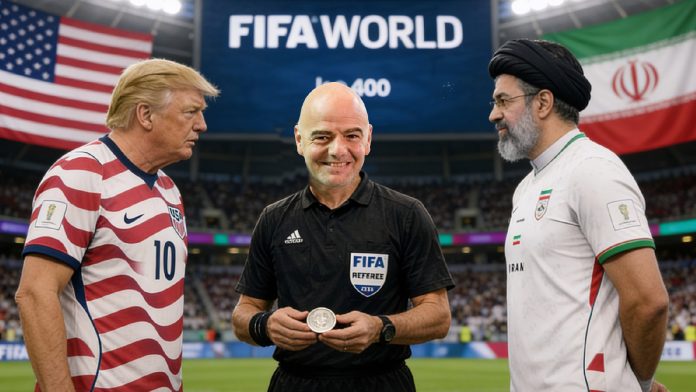
The 2026 World Cup, the planet’s top sporting event, is just around the corner. But the three host countries—Mexico, United States, and Canada—continue to be embroiled in diplomatic squabbles, which are straining the pre-tournament atmosphere. And in other parts of the globe, conflicts continue to cast doubt on whether the event can proceed without incident.
The 48 teams competing in the World Cup represent a quarter of the UN’s member states and account for about 60% of global GDP. Nearly all G7 countries are represented, with the exception of Italy, and Europe is the most heavily represented continent, with 16 teams. But the almighty FIFA, which has more members than the United Nations (211 versus 193), has decided to increase the representation of other regions with influence in platforms such as the G20 and the BRICS. Latin America and the Caribbean will make a strong showing with 19 countries, as will Africa and the Middle East (9).
At the lowest point in the UN’s 80-year history, with armed conflicts and political challenges that have undermined its effectiveness, FIFA stands as proof that multilateralism is not dead—even if it is not alive in the political sphere. “We spend a lot of time talking about what divides us, but we realized that, when you bring a group of people together, there are far more things that unite them than separate them,” said its president, Gianni Infantino, a few days ago speaking at the United Nations headquarters in New York.
The chameleon-like FIFA president isn’t just in his element in the halls of international diplomacy. He’s also at home in high-profile public settings, such as Formula 1 races or pop music festivals. Everywhere he goes, his unmistakable bald head and winning smile stand out—whether he’s handing out soccer balls to barefoot children in a poor neighborhood in Kenya, presenting an inexplicable “Peace Prize” to Donald Trump, or signing a multibillion-dollar sponsorship deal with Aramco, the Saudi regime’s oil company. Such is the geopolitics of FIFA, where soccer, diplomacy, and millions coexist in equal measure.
Kickoff
The World Cup kicks off on June 11, shortly after the start of the challenging renegotiation of the USMCA, the free trade agreement between the three host countries. The agreement expires on July 1, right in the middle of the tournament’s decisive matches. “The image we’ll see in June is that of three flags on the tournament banner while the governments negotiate their trade agreements in parallel from very opposing, very hostile positions,” says Ángel Badillo Matos, an expert in global governance at the University of Salamanca.
“It’s a contradiction without precedent in the history of the World Cup. And if anyone wonders whether soccer can coexist with politics, the answer is that it can try, even though the backdrop is very complicated. But especially from a geopolitical standpoint, the element that I believe is the most explosive (in this World Cup) is the issue of immigration bans,” he adds.
The Spanish expert points out one of the aspects behind Infantino’s enigmatic smile. The United States, where 65% of the World Cup matches will be played, has imposed restrictions on citizens from 50 countries, including four that will be competing: Ivory Coast, Haiti, Senegal, and Iran.
The case of the Persian nation is the most sensitive: with less than two weeks to go before the tournament begins, negotiations between Washington and Tehran are still ongoing to end the war in the Middle East. A conflict that has not only claimed thousands of lives in Iran and other countries in the region, but has also thrown the oil industry—one of FIFA’s biggest sponsors—into disarray.
But there is more to it than that. “From an environmental standpoint, this World Cup is going to be tremendously polluting,” explains Badillo Matos. Record distances that delegations and fans will have to travel (for example, there are 4,000 kilometers between Mexico City and Vancouver, two of the host cities) will generate the largest carbon footprint of any World Cup held to date.
“At the same time, FIFA signed an agreement with the Saudi state-owned oil company Aramco, which is the world’s largest emitter of greenhouse gases. And a few months later, that country was chosen to host the 2034 World Cup,” the interviewee adds.
Millions at Stake
The fact is that its size and social significance cannot hide unspeakable truths. “FIFA is one of the most corrupt organizations in the world,” says Alejandra Marmolejo, who holds a Ph.D. in Public Policy from the Tecnológico de Monterrey. For this Mexican scholar, there is an economic objective behind the selection of the 2026 World Cup host: to win over the audience that follows the NFL (the American football league).
“La FIFA e Infantino tienen la intención de acaparar el mercado estadounidense, o sea, lo que pretenden es tener más presencia en Estados Unidos, es un trasfondo más económico que diplomático”, sostiene Marmolejo. Y el polémico Premio de la Paz entregado a Trump está en el fondo de este objetivo. “La FIFA le otorgó un reconocimiento asociado a la paz, o al entendimiento internacional, en medio de una etapa marcada por discursos expansionistas, endurecimiento fronterizo y estrategias de presión continental. Este gesto se interpretó como un movimiento político para buscar aprobación del gobierno estadounidense, y que el círculo cercano de Trump le otorgara un voto de confianza a la FIFA para administrar los recursos financieros en torno al Mundial”, analiza la experta.
According to estimates, the World Cup will generate 10.9 billion dollars in revenue for the organization led by Infantino—56% more than the previous edition in Qatar 2022, and double the amount generated by the 2018 World Cup in Russia.
But in this diplomacy of interests, Trump also needs FIFA. As Marmolejo points out, in a context where the Republican is seeking to reestablish “the hemispheric idea of American power,” the World Cup serves as “a platform for projecting regional leadership without directly resorting to the language of coercion. Hosting the World Cup allows the United States to be presented as the continent’s leading player, a hub for security, business, and entertainment, while Mexico and Canada appear as the United States’ subordinate nations.”
FIFA, Conmebol and the AFA
“The world will come to a standstill and all eyes will be on North America,” Infantino boasted in his speech at the UN on May 23. The FIFA chief is confident that, once the ball starts rolling on the fields of Mexico, Canada, and the United States, the agenda of global conflicts will take a back seat. It is the metaphor of the globe transformed into a soccer ball—a sport that leaders like Trump, Claudia Sheimbaum, and Canada’s Mark Carney have never played, nor has Iran’s new Ayatollah, Mojtaba Khamenei.
Everyone will set aside their differences while the Cup is being played, or at least hide them behind soccer multilateralism. It’s a strategy that doesn’t always work: Infantino’s failure at the most recent FIFA Congress in April when he was unable to get the representatives from Israel and Palestine to shake hands is still fresh in people’s minds.
The clouds of scandal hanging over world soccer’s leadership due to financial mismanagement in various federations will not disappear either. For example, CONMEBOL, the governing body of soccer in South America. An investigation by the New York Times has just accused its president, Paraguayan Alejandro Domínguez, of receiving millions of dollars from funds recovered in the wake of FIFA-Gate, the widespread scandal that rocked the organization’s leadership in 2015. Another official, Claudio Tapia—head of the highly influential Argentinian federation—is facing legal charges in his country for illicit enrichment.
In recent months, neither of them has missed an opportunity to be seen standing side by side with Infantino, as if to demonstrate that they have his support. “FIFA legitimizes leaders who might otherwise be questioned, as in the cases of Domínguez or Tapia,” says lawyer and journalist Juan Pablo Zaracho, who follows CONMEBOL’s day-to-day activities from Asunción. He asserts that both the Paraguayan and the Argentinian are now loyal to Infantino, even though they were not always so close. And that they do so because “they know that being close to power is what keeps them in their positions.”
In other words, they apply the lessons of soccer’s geopolitics. As Zaracho puts it, this consists of “adapting and aligning oneself with power no matter what happens; without criticizing, without questioning. It has been a consistent feature throughout FIFA’s history.” There are historical examples such as the highly controversial World Cups in Italy ’34, Argentina ’78, and even Russia 2018, where FIFA (and its presidents) chose to look the other way and, instead of raising objections, gave way to their motto: Soccer unites the world. At least for the photos.